
MORTAL AIR
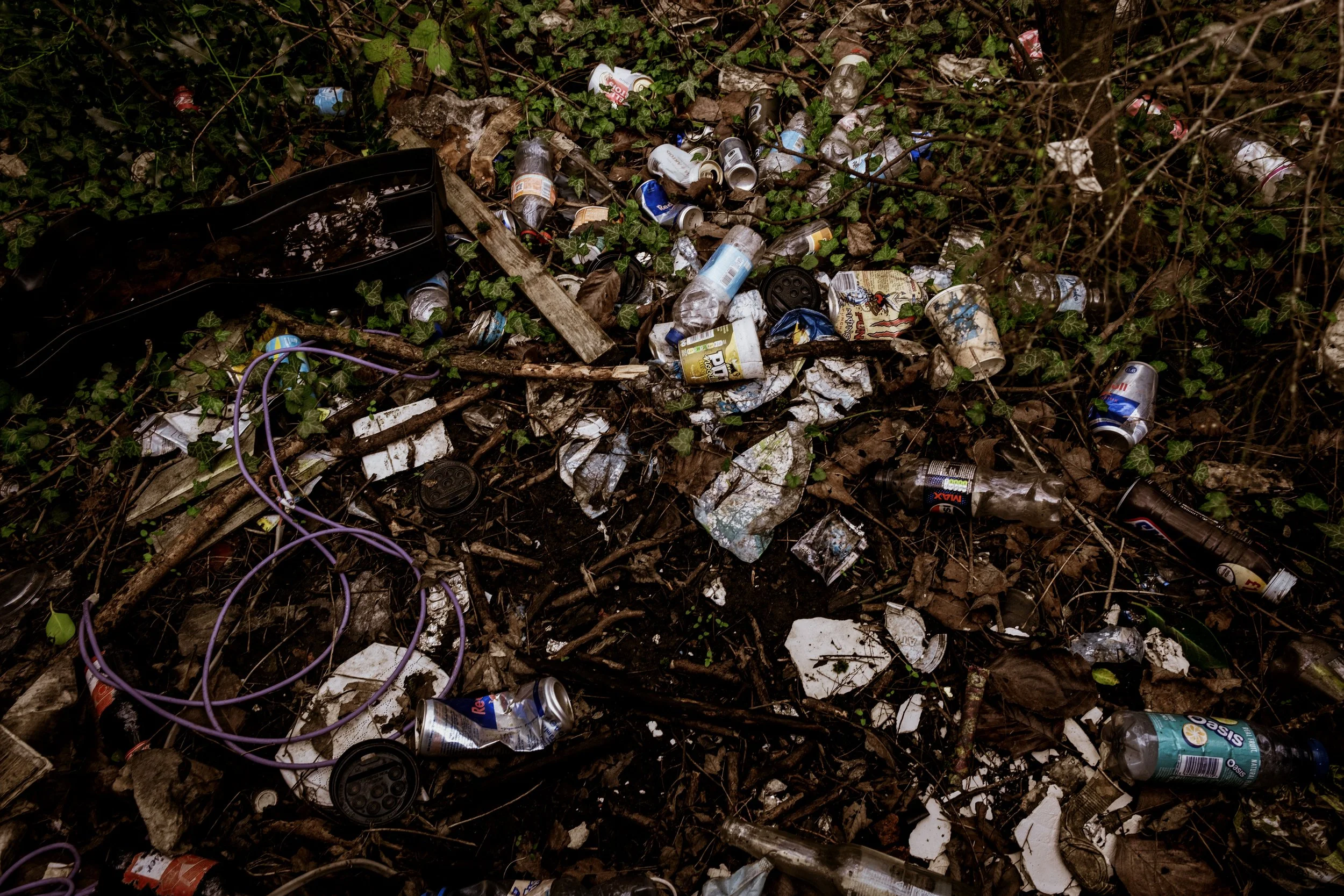
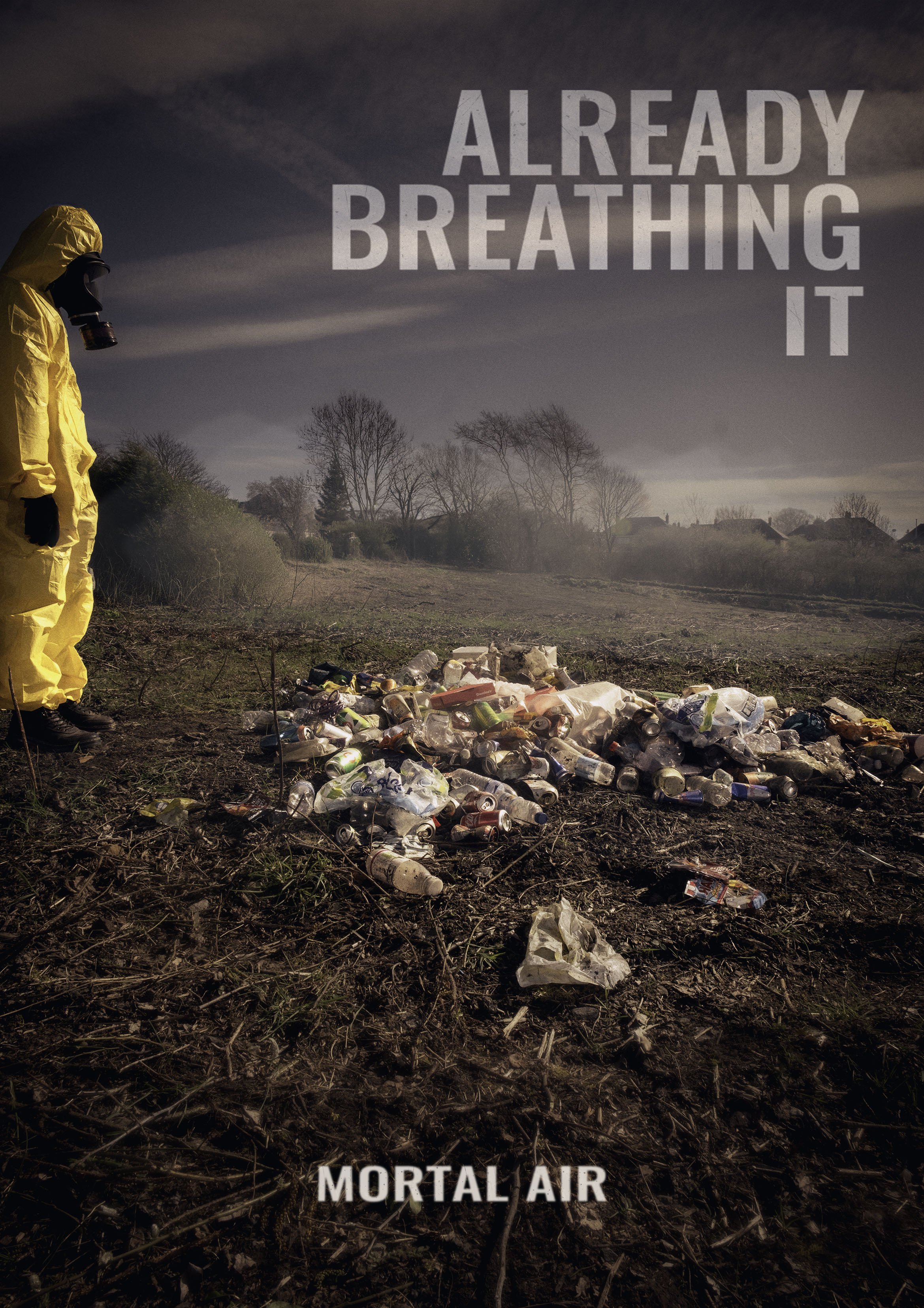
Mortal Air is a constructed environmental photography project that explores plastic pollution, litter and the way disposable waste has become embedded into everyday life. The work began from a simple observation: people walk past rubbish constantly, but because it is so common, they often stop reacting to it.
Designed to Last, Used for Minutes
Cigarette filters are especially important within this project because they are small, easy to ignore and often treated as if they are harmless. In reality, cigarette butts are one of the most littered items in the world. Around 4.5 trillion cigarette butts are estimated to be littered globally each year, ending up in soil, rivers, lakes and oceans. Many filters contain cellulose acetate, a form of plastic, meaning they can break down into smaller plastic fibres rather than simply disappear.
Plastic packaging creates a similar problem. It is used because it is cheap, light, waterproof and convenient, but those same qualities make it difficult to deal with once it becomes waste. The United Nations Environment Programme states that humanity produces more than 430 million tonnes of plastic every year, with around two-thirds of that made up of short-lived products that soon become waste. This matters because much of the plastic seen as everyday litter was never designed to be valued for long. It was designed to protect, wrap, brand or transport something, then be thrown away.
The image used in this section shows that idea visually. The waste is not presented as a single shocking object. It is an accumulation. Bottles, cans, wrappers and fragments sit among soil, leaves, branches and plants. Natural and artificial materials become tangled together. The landscape is still recognisable as an outdoor space, but it has been interrupted by human-made waste. This makes the image uncomfortable because the pollution does not look separate from the environment. It looks embedded within it.
That is what Mortal Air is trying to make visible. The project does not treat litter as a small inconvenience or something that only makes a place look untidy. It treats litter as a sign of a society that has become too comfortable with disposable materials. When rubbish becomes normal, responsibility becomes easier to avoid. People walk past it. Companies continue producing it. Governments struggle to manage it. The environment is left to absorb the consequences.
The Waste We Stop Seeing
Litter is rarely shocking at first. It does not always appear as a dramatic environmental disaster. More often, it appears as small, ordinary objects left in ordinary places: a bottle in a hedge, a wrapper on the pavement, cigarette filters near a drain, takeaway packaging caught in grass, or a crushed can pushed into the side of a path. These objects are visible, but because they are so common, they often blend into the background.
This is one of the main ideas behind Mortal Air. The project looks at how waste becomes normal through repetition. When people see the same type of rubbish every day, they can stop noticing it as a problem. It becomes scenery. A plastic bottle no longer feels like pollution. A cigarette filter no longer feels like toxic waste. A food wrapper no longer feels connected to production, consumption or corporate responsibility. It simply becomes another object on the ground.
That normalisation is dangerous because litter is not just mess. It is evidence of a much larger system. Every discarded bottle, wrapper, cup, packet or filter began as a designed product. It was manufactured, packaged, transported, sold, used and then abandoned. By the time it appears on the floor, it has already passed through a chain of decisions involving material choice, branding, convenience, profit and disposal.
The scale of this problem is much larger than one street or one image. Keep Britain Tidy’s A Rubbish Reality report found that only nine out of every 100 places surveyed in England were completely litter-free. That means litter is not an occasional problem. It is present across streets, parks, housing areas, retail spaces, roadsides and public environments. The report also identified common litter items such as cigarette butts, sweet wrappers, chewing gum wrappers, drink bottles and cans. These are exactly the kinds of objects people often stop seeing because they are so familiar

Plastic was not originally created as waste. It began as a material of possibility: strong, mouldable, lightweight, waterproof and adaptable. Early plastics were developed to replace expensive or limited natural materials such as ivory, horn, tortoiseshell and shellac. In that context, plastic was seen as progress. It could reduce reliance on some animal-derived materials, make products cheaper and allow objects to be manufactured at scale.
That history matters because Mortal Air is not arguing that plastic was always useless or evil. The issue is more complex than that. Plastic became a problem when a material designed for durability became part of a disposable culture.
A plastic bottle might be used for ten minutes. A crisp packet might be opened and thrown away in seconds. A takeaway container might be used once. A coffee cup lid might only exist to carry a drink from one place to another. Yet these objects are made from materials that can remain in the environment for decades or longer. They may break apart, but breaking apart is not the same as disappearing.
This contradiction sits at the centre of the project: plastic is designed to last, but much of it is used as if it has no future.
The scale of plastic production makes this problem even more serious. The United Nations Environment Programme states that humanity produces more than 430 million tonnes of plastic every year, with around two-thirds of that made up of short-lived products that soon become waste. This means that much of the plastic produced globally is not designed for long-term use. It is designed for convenience, packaging, branding and disposal.
That is why plastic waste is not only a problem of individual behaviour. It is also a design problem. Before a bottle, wrapper, packet or container becomes litter, it has already been created as part of a system that accepts short-term use and long-term environmental impact. The consumer may throw it away, but the object was already designed around disposability.
Plastic is still used because it solves problems for companies. It protects food, extends shelf life, keeps products clean, reduces weight during transport and makes packaging easy to seal, print, stack and sell. For supermarkets and manufacturers, plastic is commercially useful. It is cheap, efficient and reliable.
But the cost does not disappear. It has been moved elsewhere.
It is pushed onto councils responsible for waste management. It is pushed onto rivers, soil, parks, oceans and wildlife. It is pushed onto communities living near landfill or waste-processing sites. It is pushed onto future generations who inherit materials they did not choose to produce. And increasingly, it is pushed into scientific conversations around microplastics, nanoplastics and long-term exposure.
Recycling is often presented as the solution, but the reality is far weaker than the public image suggests. Globally, only around 9% of plastic waste is successfully recycled. The rest is incinerated, sent to landfill, mismanaged, or leaked into the environment. This means recycling has a role, but it cannot solve the problem on its own.
Part of the issue is that plastic is not one single material. Different plastics have different chemical structures, uses, and recycling limits. Food contamination, mixed materials, dark plastics, flexible films, laminated packaging and low-value plastics can all make recycling more difficult. Even when plastic is collected, it does not automatically become a new product.
This is why Mortal Air focuses on reduction rather than just disposal. The question is not only, “Where does this plastic go after we use it?” The stronger question is, “Why was this plastic necessary in the first place?”
If a material lasts for decades, it should not be used casually for objects designed to be thrown away after minutes. That mismatch reveals a wider failure in how products are designed, sold and consumed. Disposable plastic allows convenience to happen immediately, while the damage is delayed and displaced.
Recycling Is Not Enough
Recycling is often presented as the main answer to plastic pollution. The public message is simple: put the plastic in the correct bin, and the problem is dealt with. However, the reality is much more complicated. Recycling has a role, but it cannot keep up with the scale of plastic production, especially when so much plastic is designed for short-term use.
Globally, only around 9% of plastic waste is recycled. According to the Organisation for Economic Co-operation and Development, 19% is incinerated, 50% ends up in landfill, and 22% is mismanaged, meaning it can be dumped, openly burned, or leaked into land and water environments. This shows that most plastic waste does not safely return to a circular system. It is either displaced, buried, burned, or left to enter the environment.
Part of the problem is that plastic is not one simple material. Different plastics have different properties, uses and recycling limits. A clear plastic bottle, a crisp packet, a black takeaway tray, a laminated label, a toothpaste tube and a coffee cup lining cannot all be recycled in the same way. Some plastics are made from several layers of material joined together. Others are contaminated by food, too small to sort properly, or too low in value to make recycling commercially worthwhile.
This means that even when people try to recycle correctly, the system does not always work in the way they expect. A plastic item placed in a recycling bin does not automatically become a new product. It still has to be collected, sorted, cleaned, processed and sold into a market that can actually use it. If that process fails at any point, the material may still end up being incinerated or sent to landfill.
This is why Mortal Air questions the idea that the recycling bin is enough. Recycling can help reduce waste, but it cannot be used as an excuse to continue producing disposable plastic at the current scale. If the majority of plastic waste is not being recycled globally, then the problem is not only disposal. The problem begins earlier, with design, production, packaging and consumption.
The United Nations Environment Programme states that more than 430 million tonnes of plastic are produced every year, with around two-thirds made up of short-lived products that soon become waste. That statistic is important because it shows that the world is not only producing plastic, but producing huge amounts of plastic that are expected to become waste quickly.
For Mortal Air, this changes the focus from individual guilt to system responsibility. People should recycle and reduce unnecessary plastic where they can, but the larger issue is that many products are designed to become waste almost immediately. The consumer is often blamed at the point of disposal, but the material choice has already been made by manufacturers, supermarkets, brands and packaging designers.
A stronger solution has to begin before plastic reaches the bin. It means reducing unnecessary packaging, designing products for reuse, supporting refill systems, improving material choices and making companies responsible for what they produce. Recycling should be part of the answer, but it cannot be the whole answer.
Plastic and the Body

Plastic pollution is often spoken about as an environmental issue, but it is increasingly becoming a human health concern as well. The problem is not only what plastic does to beaches, rivers, soil and wildlife. It is also what happens when plastic breaks down into particles small enough to move through air, water, food systems and potentially the human body.
Microplastics are tiny plastic particles created when larger plastic items break apart, or when small plastic fibres and fragments are released from products during use. They can come from degraded packaging, synthetic clothing, tyre dust, personal care products, industrial materials and everyday plastic waste. Nanoplastics are even smaller, which makes them more difficult to detect and raises further questions about how they may move through biological systems.
This is important because plastic does not simply disappear when it becomes too small to see. It changes form. A bottle, wrapper or cigarette filter left in the environment can fragment over time through sunlight, weathering, abrasion and physical damage. These fragments can then move through soil, drains, rivers, oceans, air and food chains. Pollution that begins as a visible object can become an invisible exposure.
Research has now detected microplastics and nanoplastics in human samples, including blood, placenta, reproductive tissue, liver, kidney and brain tissue. This does not mean every exposure automatically causes disease, and it would be inaccurate to claim that the full health impact is already understood. However, detection matters. It shows that plastic pollution is not only outside the body. It is now part of a wider conversation about human exposure, long-term risk and the materials we allow into everyday life.
The reproductive health concerns are especially relevant because some studies have detected plastic particles in semen, placental tissue, breast milk and follicular fluid. Research in this area is still developing, but these findings make it harder to treat plastic pollution as something distant or purely environmental. If plastic particles are being found in areas connected to reproduction and development, then the issue becomes more personal, more intimate and more urgent.
Alongside plastic particles, there are also concerns around chemicals connected to plastic production and use. Phthalates, bisphenols and PFAS are often discussed in relation to endocrine disruption, hormone systems, fertility, inflammation and long-term health risk. These chemicals are not all the same, and they should not be treated as one single threat, but they do show that plastic is not just a neutral material. It can carry additives, coatings and chemical residues that complicate its impact.
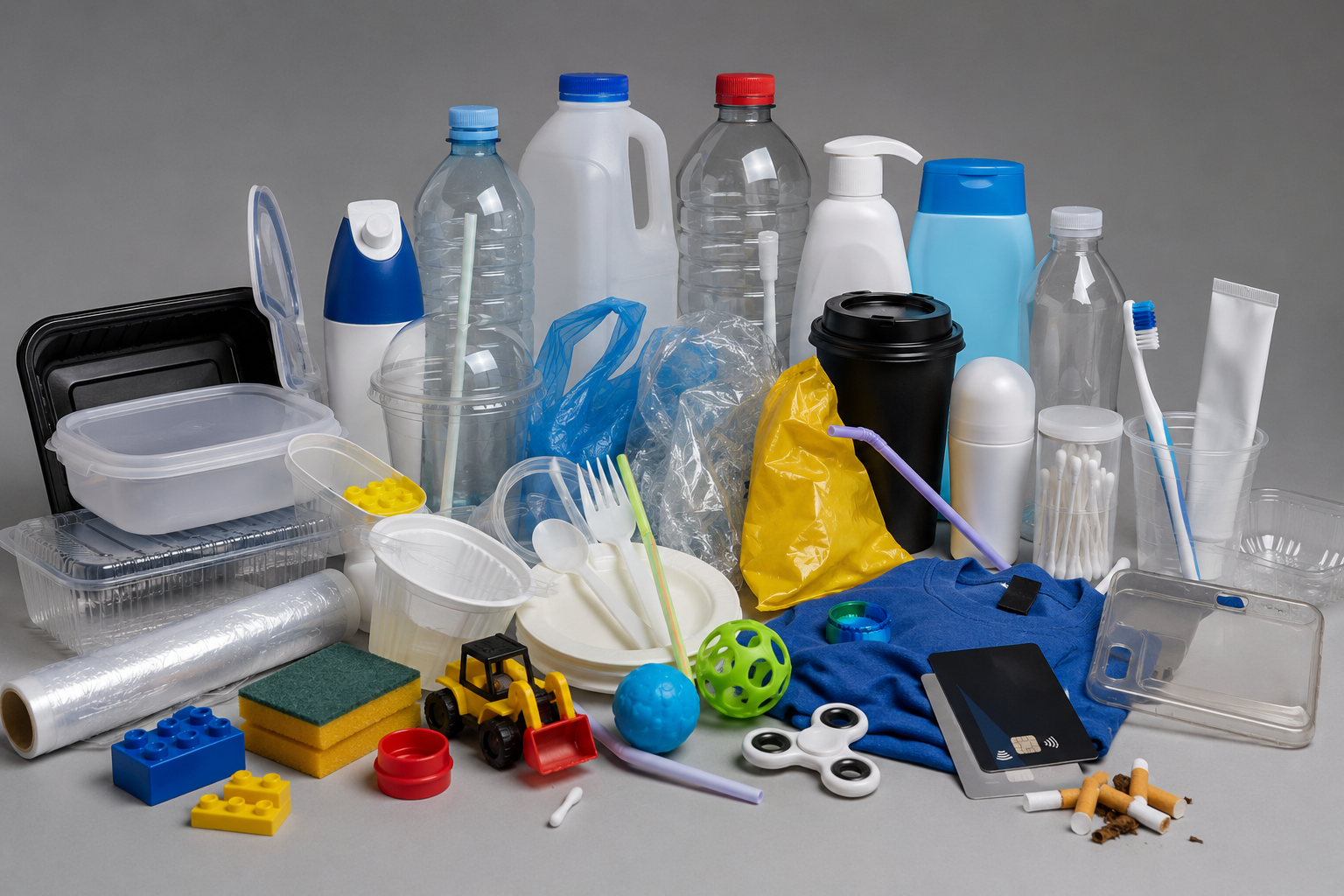
This is why Mortal Air does not present plastic as harmless just because it is familiar. Familiarity can make risk feel ordinary. Food wrapped in plastic, drinks stored in plastic bottles, children’s toys, dog toys, synthetic clothing, cooking utensils, takeaway containers and body care packaging all show how closely plastic sits against daily life. These are not extreme examples. They are normal products, which is exactly why they matter.
The idea of a “plastic detox” within this project is not used as a quick wellness trend. It is used to describe a more serious reduction of unnecessary plastic contact, especially around food, drink, heat and personal care. This could mean avoiding heating food in plastic containers, using glass or metal bottles, choosing refillable products, reducing disposable packaging and becoming more aware of the materials brought into the home.
However, this section is not about blaming individuals for every exposure. Most people live inside systems where plastic is difficult to avoid. Food is packaged before it reaches the customer. Products are designed before they appear on shelves. Supermarkets, manufacturers and brands often make the material choices long before the consumer is involved. That means personal reduction matters, but systemic change matters more.
For Mortal Air, the health discussion strengthens the meaning of the title. Air, water, food and materials are shared conditions. Pollution is not separate from the body just because it begins outside it. The project uses photography to make that connection visible, turning plastic from an ignored object on the ground into a warning about the environments we create and the materials we normalise.
The point is not to create panic. The point is to ask why society has become so comfortable surrounding bodies, homes, food, animals and public spaces with materials that last far longer than the products they are used for.
Plastic pollution is often treated as something outside the body. It is seen as waste in streets, rivers, parks, oceans and landfill sites. But the problem becomes more urgent when plastic is understood not only as something around us, but as something that may move through the systems we depend on: air, water, food and the human body.
When plastic breaks down, it does not simply disappear.
Plastic in Everyday Life
Plastic pollution is not only something seen in rivers, oceans or landfill sites. It is also built into the ordinary objects people use every day. This is one of the reasons it can be difficult to question. Plastic is so present in modern life that it often disappears into routine.
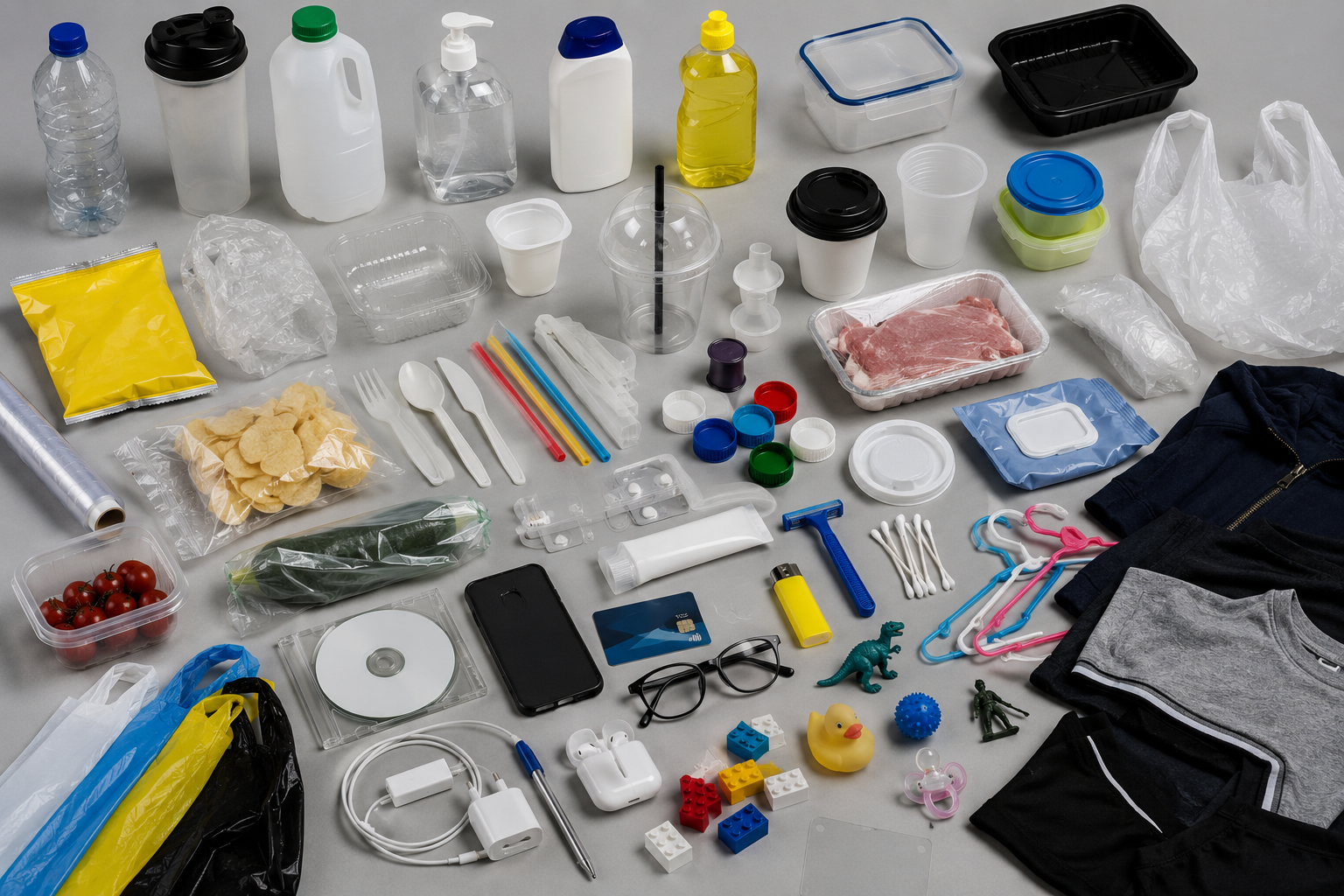
Food is wrapped in it. Drinks are bottled in it. Takeaway meals are carried in it. Toiletries are packaged in it. Clothes can be made from synthetic fibres. Children’s toys and dog toys are often plastic or rubber-based. Kitchen utensils, chopping boards, storage tubs, cling film, bottle lids, labels, wrappers and packets all show how normal plastic has become.
The issue is not only the objects people clearly recognise as plastic. It is also the materials that are hidden or easily overlooked. Drinks cans can contain internal plastic linings. Coffee cups can use plastic coatings to stop liquid soaking through the paper. Clothing made from polyester, nylon or acrylic can shed tiny synthetic fibres during washing. Laminated packaging can combine plastic with paper, foil or card, making it harder to recycle. Plastic is not always visible, but it is often present.
This matters because the body comes into contact with plastic through repeated everyday use. People eat food that has been stored or wrapped in plastic. They drink from plastic bottles. They touch plastic packaging, use plastic utensils and bring plastic products into their homes. Children and animals may chew plastic toys. These examples are ordinary, but that is exactly why they are important. The problem is not rare exposure. It is constant exposure.
For Mortal Air, this everyday presence of plastic is central to the project. The work is not only about waste after it has been thrown away. It is about the full life of plastic: how it is designed, how it is sold, how it is used, how quickly it is discarded and how long it remains afterwards. A wrapper on the floor is only the final stage of a much wider system.
This is why the project uses visual language that feels direct and uncomfortable. Plastic pollution is easy to ignore when it is presented as a distant environmental issue. It becomes harder to ignore when it is connected to food, homes, bodies, children, animals and the materials people touch every day.
The aim is not to suggest that every plastic object is equally dangerous or that plastic can disappear overnight. Some plastic has important uses, especially in medicine, safety and long-lasting products. The issue is unnecessary plastic, disposable packaging and products designed with no realistic end-of-life solution.
By focusing on everyday objects, Mortal Air asks viewers to reconsider what they accept as normal. A plastic bottle, wrapper or packet may appear ordinary, but each one belongs to a system of extraction, production, branding, consumption and waste. The more familiar these objects become, the easier it is to ignore the damage they leave behind.
Plastic pollution is often spoken about as an environmental issue, but it is increasingly becoming a human health concern as well. The problem is not only what plastic does to beaches, rivers, soil and wildlife. It is also what happens when plastic breaks down into particles small enough to move through air, water, food systems and potentially the human body.
Microplastics are tiny plastic particles created when larger plastic items break apart, or when small plastic fibres and fragments are released from products during use. They can come from degraded packaging, synthetic clothing, tyre dust, personal care products, industrial materials and everyday plastic waste. Nanoplastics are even smaller, which makes them more difficult to detect and raises further questions about how they may move through biological systems.
This is important because plastic does not simply disappear when it becomes too small to see. It changes form. A bottle, wrapper or cigarette filter left in the environment can fragment over time through sunlight, weathering, abrasion and physical damage. These fragments can then move through soil, drains, rivers, oceans, air and food chains. Pollution that begins as a visible object can become an invisible exposure.
Research has now detected microplastics and nanoplastics in human samples, including blood, placenta, reproductive tissue, liver, kidney and brain tissue. This does not mean every exposure automatically causes disease, and it would be inaccurate to claim that the full health impact is already understood. However, detection matters. It shows that plastic pollution is not only outside the body. It is now part of a wider conversation about human exposure, long-term risk and the materials we allow into everyday life.
The reproductive health concerns are especially relevant because some studies have detected plastic particles in semen, placental tissue, breast milk and follicular fluid. Research in this area is still developing, but these findings make it harder to treat plastic pollution as something distant or purely environmental. If plastic particles are being found in areas connected to reproduction and development, then the issue becomes more personal, more intimate and more urgent.
The Body Becomes the Landscape
It fragments into smaller and smaller particles, including microplastics and nanoplastics. These particles can come from packaging, synthetic clothing, tyre dust, degraded plastic objects, cigarette filters, food containers and other everyday materials. Once released, they can move through soil, waterways, air and food chains.
Research has detected tiny plastic particles in human samples, including blood, placenta, reproductive tissue and organs. This does not mean every exposure automatically causes disease, and the science is still developing. However, it does show that plastic pollution can no longer be understood as something completely separate from human life. The boundary between environment and body is becoming harder to ignore.
There are also concerns around plastic-related chemicals, including phthalates, bisphenols and PFAS. These chemicals are often discussed in relation to hormone disruption, fertility, inflammation and long-term health concerns. The point of Mortal Air is not to create panic or make unsupported medical claims. The point is to question why society has become comfortable surrounding food, drink, children, animals and bodies with materials that are designed to last far longer than the products they are used for.
This section of the project connects directly to the title Mortal Air. Air is shared. It moves between bodies, streets, homes and landscapes. If pollution exists in the environments people live in, then it cannot be treated as distant or separate. Mortal Air uses photography to make this connection visible, turning plastic from an ignored object on the ground into a warning about exposure, consumption and responsibility.
The Work in an Exhibition Setting
In an exhibition setting, Mortal Air is intended to feel more like a public warning than a traditional photographic display. The work is not designed to sit quietly on a wall as decorative imagery. It is made to confront the viewer, using scale, atmosphere, material choices and direct visual language to make plastic pollution feel immediate.
The photographs use the language of environmental campaign advertising: staged scenes, controlled lighting, strong composition and slogan-based messaging. This allows the work to sit between photography, graphic design and visual activism. Rather than simply documenting litter, the images frame waste as evidence of a wider system of production, consumption and neglect.
The exhibition space extends that idea beyond the photograph. The use of a brown wall creates a grounded, earth-like atmosphere rather than a clean white gallery environment. It connects visually to soil, dirt, decay and contamination, making the space feel closer to the polluted landscapes explored in the work.
The fake grass brings the suggestion of an outdoor environment into the gallery. However, because it is artificial, it also creates a contradiction. It looks like nature, but it is not nature. This reflects one of the central concerns of the project: plastic often imitates, replaces or damages natural materials and spaces.
The litter placed on the fake grass makes the issue physical. The rubbish is not only represented inside the photographs. It enters the viewer’s space. It turns the floor into a polluted landscape and asks the audience to look down at the kind of waste they might normally step over outside. This makes the display harder to ignore because the viewer is no longer separated from the subject.
The gas mask also becomes an important part of the exhibition. It brings an object from the visual world of the project into the real space of the audience. As a symbol, it suggests protection, contamination and the possibility of an environment that has become unsafe to breathe. It connects directly to the title Mortal Air, making the idea of polluted air feel physical rather than abstract.
The written audience response adds another layer to the work. Viewers are invited to reflect on how it would feel if needing protection from the outdoor environment became normal, or what kind of future is being created through continued plastic use and pollution. This turns the audience from passive observers into participants. They are not only looking at the work; they are being asked to respond to it.
Together, the photographs, wall colour, artificial grass, litter, gas mask and written responses create an exhibition space that surrounds the viewer with the issue. Mortal Air is not only a set of images about pollution. It is a constructed encounter with pollution, designed to make the viewer question what they have stopped noticing.
Why It Matters
Mortal Air matters because plastic pollution is not only an environmental problem. It is also a social, visual and material problem. It affects the spaces people live in, the products they use, the food they buy, the air they breathe and the systems they depend on.
The project does not present plastic as a simple issue with a simple solution. Plastic can be useful, especially in medicine, safety, technology and long-lasting products. The problem is the scale of unnecessary plastic use, especially disposable packaging and short-lived products that quickly become waste.
This is why the project looks beyond individual littering. A bottle on the ground is not only the result of one person dropping it. It is also the result of design, manufacturing, branding, selling, convenience and weak end-of-life responsibility. By the time plastic appears as waste, it has already passed through a much larger system.
The project argues that responsibility has to be shared. Individuals can reduce unnecessary plastic use, recycle where possible and question their habits, but corporations and governments have far greater power to change the system. Supermarkets, manufacturers and packaging designers decide how products are wrapped, sold and disposed of before they even reach the public.
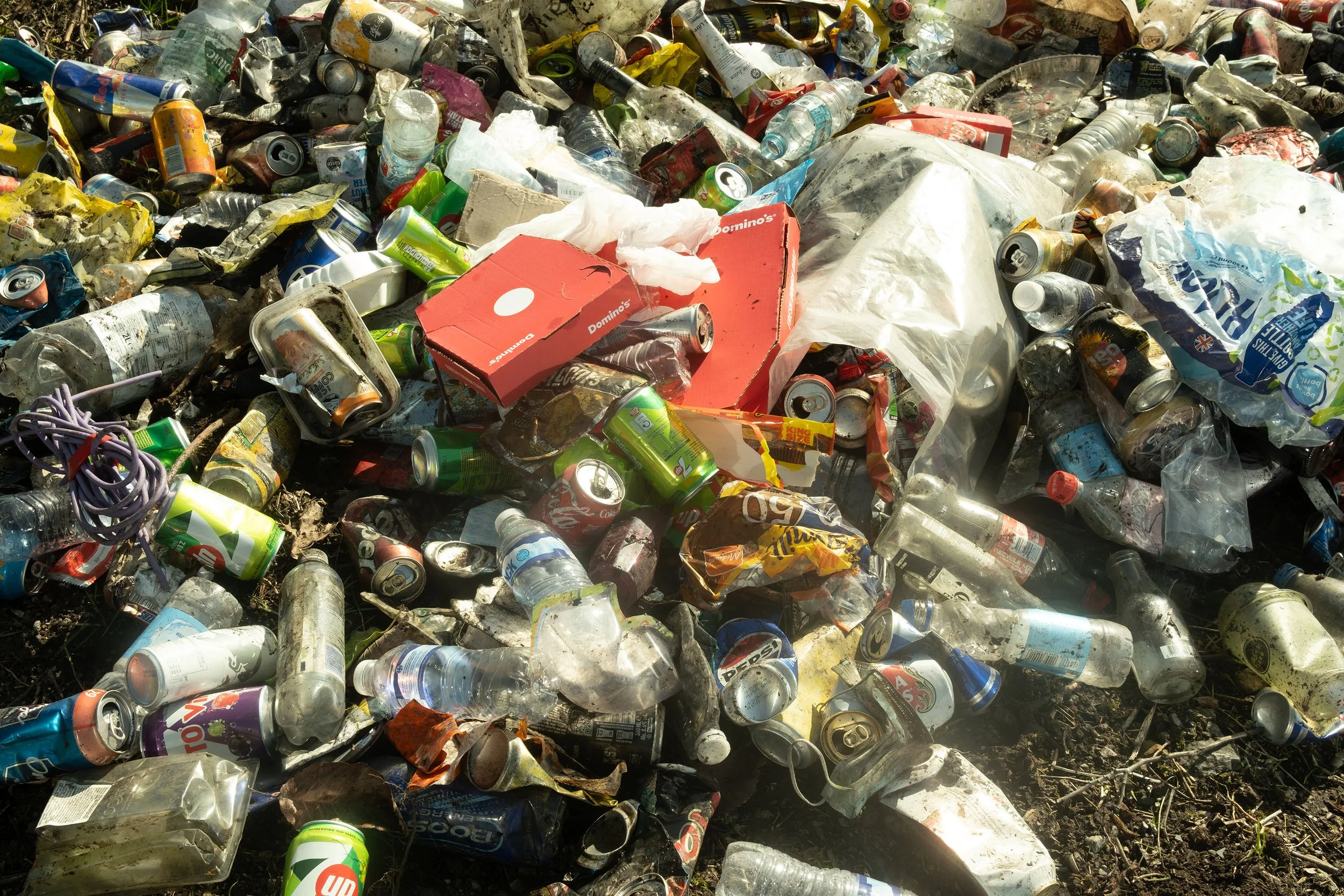
For me, photography is a way of making that system visible. Mortal Air uses constructed imagery, real collected litter, campaign-style slogans and exhibition design to make familiar waste feel uncomfortable again. It asks viewers to stop seeing plastic as background detail and start seeing it as evidence of a wider problem.
A Call for Change
Plastic began as a solution. It became a convenience. Now it has become a warning.
Mortal Air asks viewers to reconsider the materials they use, the waste they walk past and the systems that make plastic feel unavoidable. The project is not arguing that every form of plastic should disappear overnight. It is arguing that society cannot keep using long-lasting materials for short-lived convenience.
Recycling alone is not enough. Individual action alone is not enough. The problem requires shared responsibility between consumers, corporations, designers, supermarkets and governments. Products need to be designed with reuse, repair, refill and realistic end-of-life solutions in mind.
The project calls for a shift away from unnecessary disposable plastic and towards materials, systems and habits that do less damage to the environment and the body. It asks people to look again at what has become normal, and to question whether convenience is worth the cost.
Plastic pollution does not end when it leaves our hands. It remains in the spaces we live in, the landscapes we move through and the future we are creating.
Project: Mortal Air
Artist: Samuel Pitchford
Medium: Constructed environmental photography, installation and campaign-style visual communication
Themes: Plastic pollution, litter, microplastics, public space, environmental responsibility and consumer culture
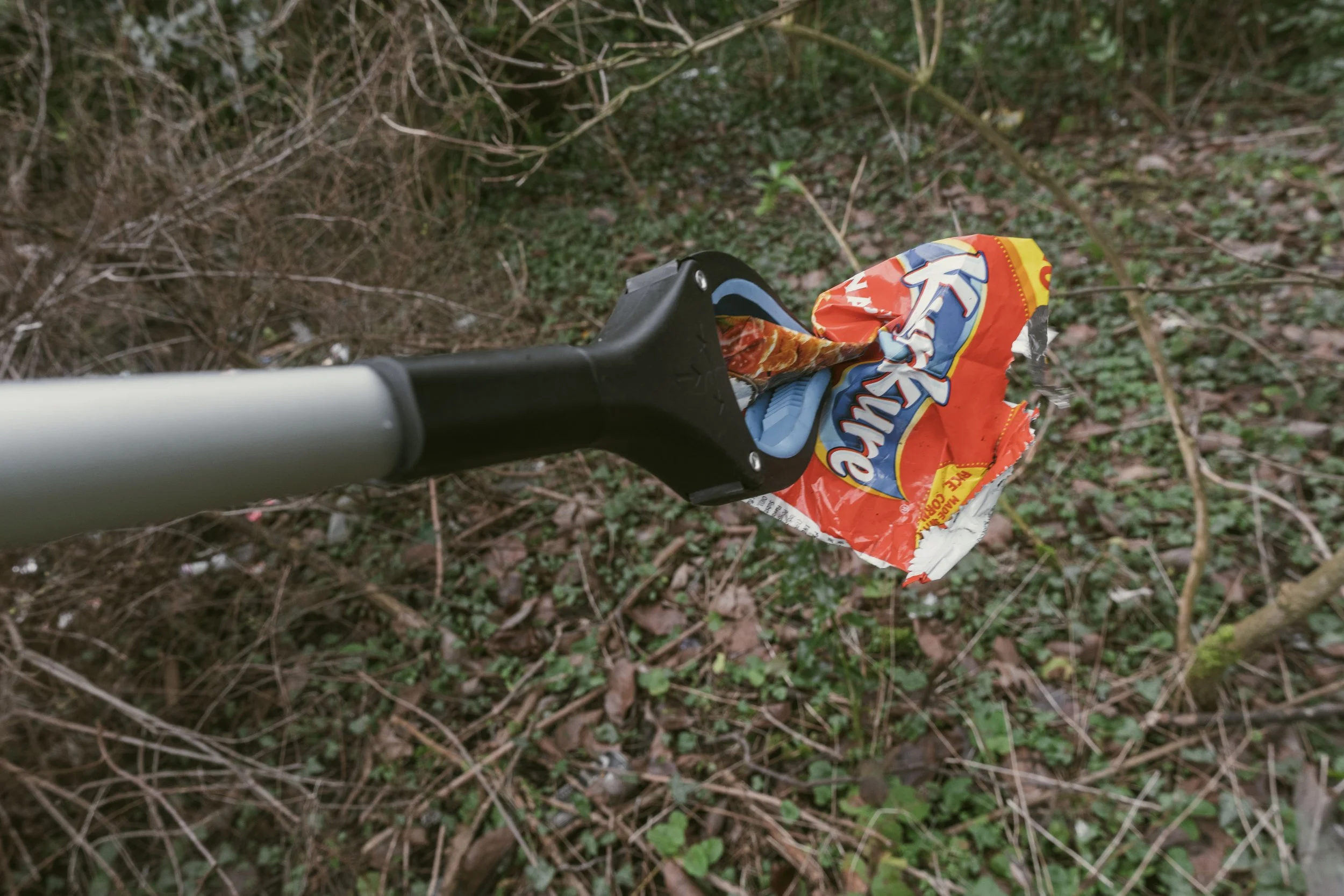
Methods: Five-hour litter pick, staged photography, controlled lighting, slogan-based design, exhibition installation and audience response
Check back in 2 weeks for more information
like alternatives to plastics